
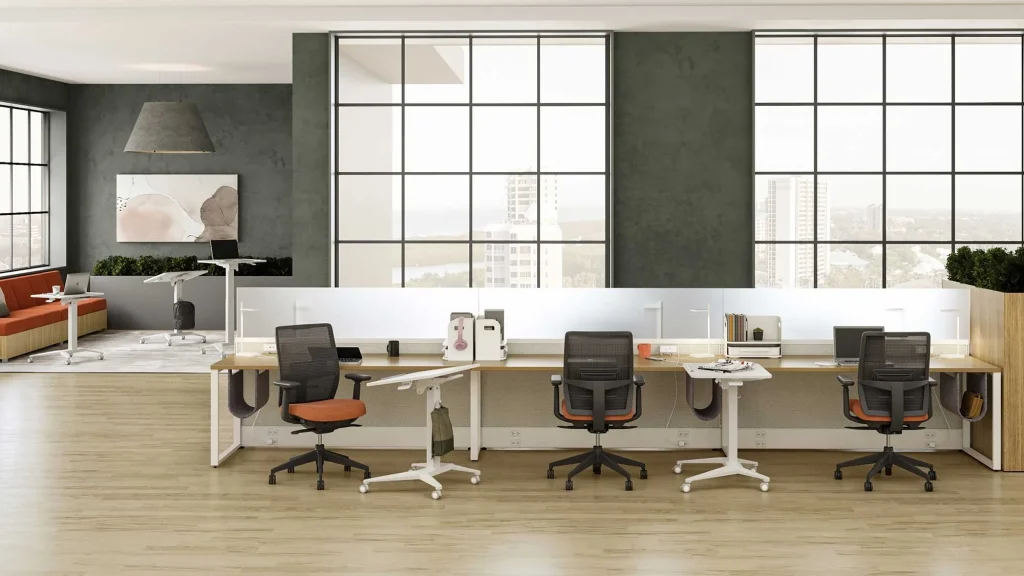
Modern Office Furniture in Dubai: The Complete Guide
Choosing the right modern office furniture is one of the highest-leverage decisions a business makes when setting up or upgrading a workspace in Dubai. At Officefurnitures.ae, we design and manufacture modern, ergonomic, and highly functional office furniture in Dubai directly from our own factory in Jebel Ali Industrial — giving startups, SMEs, and enterprises across the UAE access to premium furniture at manufacturer-direct prices, with free 3D design consultation, same-day delivery across DIFC and Business Bay, and free installation on every order.
This guide is intentionally thorough. It covers what modern office furniture actually means, how to plan and budget a fit-out room by room, the materials and ergonomic features worth paying attention to, current design trends in Dubai offices, common mistakes to avoid, and answers to the questions we hear most often from businesses across Dubai, Abu Dhabi, and the wider GCC. Use the contents below to jump to the section most relevant to you, or read start to finish if you’re planning a full fit-out.
What’s Covered in This Guide
- What is modern office furniture?
- Why modern office furniture matters
- Our modern office furniture collection
- How to choose office furniture
- Office furniture by room
- Materials and finishes explained
- Ergonomics: what actually matters
- Common mistakes to avoid
- Custom and bespoke solutions
- Sustainability in office furniture
- Modern office furniture trends
- Budgeting for a fit-out
- Our office fit-out process
- Why businesses choose Officefurnitures
- Who we work with
- Open-plan vs. private offices
- Furniture considerations by Dubai district
- Economic vs. custom vs. executive furniture
- Sample furniture plans by office size
- Signs it’s time to replace your furniture
- Maintenance and care guide
- Glossary of office furniture terms
- Frequently asked questions
What Is Modern Office Furniture?
Modern office furniture refers to desks, seating, storage, and layout systems designed around three principles: clean, minimal lines; genuine functionality; and materials suited to how people actually work today. Unlike traditional heavy wood-paneled furniture, modern pieces tend to favor engineered boards, powder-coated steel, tempered glass, and breathable performance fabrics — finishes that look sharp under Dubai’s bright office lighting and hold up to daily commercial use.
The shift from traditional to modern office furniture didn’t happen overnight. Older office design assumed fixed hierarchies: large private offices for management, dense rows of identical desks for everyone else, and heavy wooden furniture meant to convey permanence. Modern design assumes the opposite — that teams reorganize often, that hierarchy is expressed more subtly, and that furniture should adapt to the business rather than the business adapting to the furniture.
A few characteristics define genuinely modern office furniture, as opposed to furniture that is simply new:
- Modularity — pieces that can be added, removed, or reconfigured as a team changes shape, rather than fixed, one-off installations.
- Ergonomic adjustability — chairs and desks that adapt to the person using them, not the other way around.
- Material honesty — finishes like exposed steel legs, tempered glass, and matte laminates that don’t try to imitate a heavier, more traditional style.
- Neutral, flexible palettes — colors and finishes that work across different branding and lighting conditions rather than a single fixed aesthetic.
- Integrated technology — cable management, power access, and monitor support built into the furniture rather than added afterward with visible cabling.
Modern doesn’t only mean “new looking.” It also means adaptable. A modern workstation should reconfigure as a team grows. A modern chair should adjust to different body types and tasks throughout a working day. A modern reception desk should say something specific about the brand behind it, rather than reading as generic furniture. When we talk about modern office furniture in Dubai, we mean furniture that is simultaneously better-looking, more comfortable, and more practical than what it replaces.
Why Modern Office Furniture Matters for Today’s Workplace
The office is no longer just a place to sit and work — it is a recruiting tool, a brand statement, and a productivity system all at once. Well-designed modern office furniture improves focus, reduces physical fatigue, and helps teams collaborate more comfortably, while also making a strong first impression on clients and visitors walking into a Business Bay or DIFC office for the first time.
As hybrid work becomes the norm across Dubai and the wider GCC, businesses are rethinking their layouts — favoring flexible workstations, ergonomic seating, and informal breakout areas over the rigid rows of identical desks that defined offices a decade ago. A few of the tangible effects of getting this right:
- Productivity — ergonomic seating and correctly sized desks reduce the fatigue and discomfort that break concentration during long work sessions, and well-organized storage cuts down time lost searching for documents or supplies.
- Retention and recruiting — candidates notice workspace quality during interviews, and current employees notice it every day. A workplace that looks and feels considered signals that the company invests in the people working there.
- Brand perception — clients and partners form an impression of your company within seconds of entering reception, well before a single conversation has happened.
- Space efficiency — modular, right-sized furniture lets a growing team use square footage more efficiently than legacy bulky furniture, which matters directly given Dubai’s commercial rents.
- Wellbeing — proper ergonomics reduces the risk of the back, neck, and wrist strain that come from long hours at a poorly set up desk, which in turn reduces avoidable sick days and discomfort-driven distraction.
- Flexibility for hybrid work — furniture that supports drop-in desking and reconfigurable meeting spaces makes it easier to run a smaller physical footprint efficiently as attendance patterns change week to week.
Whether you’re fitting out a brand-new office in Business Bay, refreshing an existing space in DIFC, or scaling a growing team into a bigger floor, the furniture you choose has a direct, compounding effect on how the business runs day to day — not just how it looks on move-in day.
Our Modern Office Furniture Collection
Officefurnitures.ae offers a complete range of office furniture in Dubai, manufactured to cover every part of the modern workplace, from the reception desk a visitor sees first to the pedestal tucked under an employee’s workstation.
Desks & Workstations
The desk is the single most-used piece of furniture in any office, and it sets the tone for how a space feels and functions. Getting the desk category right across a fit-out means matching desk type to the work happening at it, rather than choosing one style for the whole floor.
- Workstation tables — modular benching systems for open-plan teams, available in linear, cluster, and back-to-back layouts to maximize headcount per square meter without feeling cramped. These are typically specified with integrated cable trays and shared power modules so that dense seating doesn’t turn into a tangle of visible cords.
- Height adjustable desks — electric or manual sit-stand desks that let employees alternate between sitting and standing throughout the day, a feature increasingly requested in Dubai fit-outs as companies invest more deliberately in employee wellbeing.
- Economic office desks — straightforward, durable desks for cost-conscious fit-outs, ideal for startups and back-office teams that need reliable furniture without the premium price tag of custom or executive lines.
- Executive tables — larger-format desks with premium finishes for leadership and management offices, built to convey authority and professionalism while still offering the storage and cable management a working desk needs.
- Reception tables — the first thing a visitor sees, designed to reflect the brand identity of the company behind it, often combining a durable work surface for reception staff with a more visually striking front-facing panel.
Meeting & Collaboration Spaces
Meeting rooms need furniture that supports focused discussion without feeling either too formal or too casual for the conversation happening around it. The table shape and scale should match the room’s actual purpose rather than simply filling the available floor space.
- Meeting tables — boardroom-scale tables for formal presentations, client meetings, and leadership discussions, typically specified with integrated power and data ports for laptops and video conferencing equipment.
- Round meeting tables — better suited to smaller huddle rooms and collaborative brainstorming sessions where a hierarchy-free layout encourages open discussion rather than a single “head of the table” position.
Ergonomic Seating
Seating is where ergonomics has the most direct, daily impact on comfort and health, since most office employees spend more consecutive hours in their chair than at any other single piece of furniture.
- Ergonomic chairs — adjustable lumbar support, seat depth, and armrests built for long working hours, usually with a synchro-tilt mechanism that lets the backrest recline in proportion to the seat.
- Task chairs — lighter-weight, everyday seating for general desk use across open-plan floors, offering core height and tilt adjustment without the full feature set of a premium ergonomic chair.
- Leather office chairs — a premium, executive feel for management offices and client-facing spaces, typically paired with a more substantial base and headrest.
- Visitor chairs — comfortable, presentable seating for guests, meeting rooms, and waiting areas, prioritizing a clean silhouette and stackability over full adjustability.
Storage & Cabinets
Storage keeps a modern office looking clean by giving paperwork, supplies, and personal items a defined place, rather than letting them accumulate on desktops and in corners.
- Filing cabinets — secure, lockable storage for physical documents that still need to be retained on-site, available in different heights to match desk-side or dedicated storage room use.
- Display cabinets — ideal for showcasing products, awards, or branded materials in reception and client-facing areas, often with glass fronts and integrated lighting.
- Planter cabinets — storage units that double as greenery dividers, a popular way to bring biophilic design into open-plan layouts without dedicating separate floor space to planting.
- Pedestals — mobile or fixed under-desk storage that keeps personal items close at hand without cluttering the desktop, usually on castors so they can move with an employee if desks are reassigned.
Lounge & Breakout Areas
Breakout spaces give employees somewhere informal to recharge, take a call, or meet without booking a formal meeting room, and they are increasingly treated as a core part of the fit-out rather than an afterthought.
- Sofas — for reception areas, breakout zones, and informal meeting corners, available in configurations from single armchairs to multi-seat sectionals.
- Coffee tables — complete lounge and waiting areas alongside sofas and visitor seating, scaled to the seating arrangement around them.
We also supply office accessories to finish every workspace down to the last detail, from cable management and monitor arms to desktop organizers and coat stands.
How to Choose Office Furniture: A Practical Buying Guide
Furnishing an office well is less about picking attractive individual pieces and more about planning a system that works together. Here is the sequence we walk clients through during a free 3D design consultation.
1. Start With Headcount and Growth Plans
Before choosing any single desk or chair, map how many people need to sit today and how many the space needs to accommodate in 12–24 months. Modular workstation systems make it far easier to add desks incrementally than fixed executive-style furniture does, so fast-growing teams should weight their budget toward flexible pieces rather than locking in a fixed layout too early.
2. Measure the Space Before You Shop
Desk footprints, walkway widths, and door clearances all constrain what furniture will actually fit and function well. A free 3D design consultation lets you see a layout mapped against real dimensions before committing to an order, which avoids the common mistake of ordering furniture that technically fits but leaves no usable circulation space around it.
3. Set a Budget by Zone, Not by Item
Rather than pricing individual chairs and desks in isolation, budget by zone: reception, executive offices, open-plan workstations, meeting rooms, and breakout areas each have different functional and visual requirements. This usually means spending more per seat in reception and executive areas, and choosing economic office desks and task chairs for back-office and operational teams where volume matters more than visual statement.
4. Prioritize Ergonomics for Anyone Sitting Long Hours
Anyone spending six or more hours a day at a desk should have an adjustable chair at minimum, and ideally a desk at the correct height for their body. This is the area where cutting corners causes the most long-term cost, in the form of discomfort, reduced productivity, and staff turnover driven by an uncomfortable workspace.
5. Decide Where Customization Is Worth It
Not every desk needs to be bespoke. Reception furniture, executive offices, and branded client-facing areas usually justify custom sizing and finishes, since these are the pieces visitors and leadership interact with most directly. Back-office workstations and storage are often better served by standard, cost-effective ranges, freeing up budget for the areas where customization has the most visible impact.
6. Plan Technology and Cable Management Early
Modern offices run on laptops, monitors, docking stations, and video conferencing equipment, and furniture should be specified with this in mind rather than retrofitted. Desks and meeting tables with built-in cable trays, grommets, and power modules keep a space looking clean and reduce the trip hazards and visual clutter that come from surface-mounted cabling added after the fact.
7. Plan Delivery and Installation Around Your Timeline
Office fit-outs are frequently timed against a lease start date or a move-in deadline. Confirming delivery windows and installation scheduling early — rather than after furniture is ordered — avoids the most common source of fit-out delays, particularly for larger orders that need to be manufactured to custom specifications.
Office Furniture by Room: A Space-by-Space Guide
Reception Areas
Reception is the first physical touchpoint a visitor has with your business, and it should be furnished accordingly. A well-proportioned reception table, paired with comfortable visitor chairs or a sofa and coffee table, does more to shape a first impression than almost any other single investment in the office. Consider sightlines from the entrance, whether reception staff need storage within reach, and how many visitors typically wait at once when sizing this zone.
Executive and Private Offices
Executive offices typically combine an executive table with a leather office chair, supporting filing or display cabinets, and a small visitor seating arrangement for one-on-one meetings. Because these are lower-volume, higher-visibility spaces, this is often where custom finishes and branding touches deliver the most value per piece, and where it’s worth spending proportionally more of the overall fit-out budget.
Open-Plan Workstations
Open-plan floors are where workstation tables or height adjustable desks matter most, paired consistently with task chairs or ergonomic chairs and individual pedestals. Consistency across the floor matters here more than in any other zone — mismatched furniture reads as disorganized at scale in a way it doesn’t with a single feature piece, and it complicates future maintenance since replacement parts and matching pieces are harder to source for a mixed inventory.
Meeting Rooms and Boardrooms
Larger boardrooms need a meeting table sized to the room and the typical group size, while smaller huddle spaces are often better served by a round meeting table, which naturally encourages more collaborative discussion than a long rectangular format. Consider acoustic treatment alongside furniture selection in glass-walled meeting rooms, since sound can carry more than expected in fully glazed spaces.
Breakout and Lounge Zones
A good breakout area gives employees somewhere to step away from a desk without leaving the building. Sofas, coffee tables, and planter cabinets combine well here to create a genuinely informal space rather than an overflow meeting room in disguise. Positioning these zones away from the densest workstation areas helps keep informal conversation from becoming a distraction for people trying to concentrate nearby.
Home Offices
Remote and hybrid arrangements have pushed demand for smaller-format versions of the same principles: a properly sized desk, a genuinely adjustable ergonomic chair, and enough storage to keep a work corner from spreading across the rest of the home. The same ergonomic principles that apply in a commercial office apply just as much at a home desk used for a full working day.
Materials and Finishes Explained
Understanding the materials behind modern office furniture helps buyers judge quality and durability, not just appearance.
- Engineered boards — the core material for most modern desks and cabinets, offering a stable, warp-resistant base that takes laminate and veneer finishes well. Quality varies significantly by density and moisture resistance, which is why manufacturing conditions and board grade matter more than they might appear to from the outside.
- Laminate finishes — scratch- and stain-resistant surfaces available in a wide range of colors and wood-grain patterns, well suited to high-traffic desks and tables that see daily use from laptops, coffee cups, and paperwork.
- Veneer finishes — a thin layer of real wood over an engineered core, giving genuine wood grain and texture at a lower cost and weight than solid wood, typically used on executive furniture where a warmer, higher-end look is wanted.
- Powder-coated steel — used for desk frames, cabinet bodies, and chair bases, valued for its durability and resistance to scratching and corrosion compared to standard painted finishes.
- Tempered glass — used as a design accent on tabletops and partitions, adding a modern, light-filled feel to meeting rooms and reception areas while remaining significantly more impact-resistant than standard glass.
- Performance fabrics and leather — seating upholstery choices that trade off breathability, cleanability, and premium feel; leather and leatherette are common in executive seating, while breathable mesh and woven fabrics dominate task chairs used for long daily sitting.
Ergonomics: What Actually Matters
Ergonomics is often treated as a marketing word, but a specific, checkable set of features is what actually makes a difference to comfort and health over a full working day:
- Adjustable seat height so feet rest flat on the floor with knees roughly level with hips.
- Lumbar support that can be adjusted in height and depth to match the natural curve of the lower back, rather than a fixed curve that suits only some body types.
- Adjustable armrests that let forearms rest level with the desk surface, reducing shoulder tension over the course of a day.
- Desk height matched to the user, or a height-adjustable desk that removes the guesswork entirely and lets the same desk suit different employees over time.
- Enough desk depth for a monitor at arm’s length, avoiding the neck strain that comes from screens positioned too close, particularly for employees using dual-monitor setups.
- Seat depth adjustment so the front of the seat doesn’t press into the back of the knees, which is a common and often-overlooked source of discomfort with fixed-depth chairs.
These are the criteria our design team checks against during a free 3D design consultation, rather than relying on generic “ergonomic” labeling alone. A chair marketed as ergonomic without genuinely adjustable lumbar support and seat depth is not delivering the benefit the label implies.
Common Mistakes to Avoid When Buying Office Furniture
After fitting out offices across Dubai, a handful of avoidable mistakes come up repeatedly:
- Buying furniture before finalizing headcount — ordering a fixed quantity of desks before growth plans are settled often means either wasted spend on unused desks or an awkward second order that doesn’t quite match the first.
- Skipping measurements — ordering from a catalogue without confirming real dimensions against the space leads to furniture that fits on paper but leaves no usable walking space in practice.
- Treating ergonomics as optional — the cost difference between a basic chair and a genuinely adjustable one is small relative to the productivity and comfort cost of getting it wrong for someone sitting eight hours a day.
- Mixing too many styles across one open-plan floor — inconsistent desks and chairs across a shared floor read as disorganized even when each individual piece is good quality.
- Underestimating storage needs — teams consistently underestimate how much filing, personal storage, and shared supply storage they’ll actually need once the office is in daily use.
- Ignoring cable management until after move-in — retrofitting cable trays and power modules after furniture is installed is more expensive and less tidy than specifying it upfront.
- Not planning for growth — choosing fixed, non-modular furniture for a team that’s likely to double within a year or two creates avoidable replacement costs later.
Custom & Bespoke Office Furniture Solutions
No two offices are the same, which is why custom office furniture in Dubai is at the core of what we do. Because we manufacture in-house at our Jebel Ali factory, every desk, cabinet, and workstation can be tailored in size, material, finish, and branding to match your space and identity — rather than forcing your office to fit a standard catalogue item.
This is especially valuable for:
- Irregular or non-standard floor plans, where off-the-shelf furniture leaves awkward gaps or requires wasted circulation space.
- Branded reception and client-facing areas, where a company’s identity needs to be reflected in the furniture itself, down to color, material, and logo integration.
- Executive office furniture intended to reflect a specific corporate look or seniority level within the organization.
- Growing teams that need a workstation system designed to scale in defined increments rather than being replaced entirely as headcount grows.
- Companies consolidating multiple offices into one location, where existing furniture from different sources needs to be replaced with a single, consistent system.
Sustainability in Office Furniture
Sustainability is an increasingly common consideration in Dubai office fit-outs, particularly for companies pursuing green building certifications or internal ESG commitments. Practical ways this shows up in furniture choices include manufacturing locally to reduce shipping-related emissions, choosing durable engineered boards designed to last well beyond a single lease cycle rather than disposable furniture that needs replacing every few years, and specifying finishes and fabrics that can be repaired or reupholstered instead of replaced outright when they show wear.
Manufacturing in-house at our Jebel Ali factory also means we can advise directly on which finishes and materials best balance durability with sustainability goals for a specific project, rather than being limited to whatever a third-party catalogue happens to offer. For companies documenting sustainability commitments as part of a lease or corporate policy, working with a local manufacturer also simplifies the sourcing and supply-chain reporting involved.
Modern Office Furniture Trends in Dubai
Dubai’s office furniture market continues to move toward flexibility and wellbeing. The trends we see most consistently requested in current fit-outs include:
- Height-adjustable desks that support sit-stand routines throughout the working day, increasingly requested as a standard rather than a premium add-on.
- Acoustic panels and privacy screens for open-plan offices, addressing the noise and privacy trade-off that comes with fewer enclosed rooms and more shared floor space.
- Biophilic touches — planter cabinets and greenery integrated directly into storage and divider furniture, bringing natural elements into spaces that would otherwise be purely functional.
- Modular workstations that can be reconfigured or expanded as teams grow, rather than replaced, reflecting a broader shift toward furniture as a long-term system rather than a one-time purchase.
- Warm, lounge-style breakout areas that sit alongside traditional desks rather than replacing them, giving teams a genuine alternative to sitting at a desk all day.
- Neutral, natural color palettes replacing the darker, heavier finishes common in older office furniture, reflecting broader interior design trends toward lighter, calmer spaces.
- Integrated technology — wireless charging pads, built-in power, and cable management as standard specification rather than an afterthought bolted on later.
If you’re planning a new fit-out or refresh, our design team can walk through which of these fit your space, team, and budget during a free consultation, rather than defaulting to whatever is currently trending regardless of fit.
Budgeting for an Office Fit-Out
Office furniture budgets vary widely depending on scope, customization, and the balance between economic and premium lines across a fit-out, so we deliberately avoid quoting generic per-desk figures that don’t reflect a specific project. That said, a few factors consistently drive cost up or down and are worth planning around before requesting a quote:
- Standard vs. custom sizing — standard catalogue dimensions are more cost-effective than fully bespoke sizing, which is worth reserving for zones where it adds the most visible value.
- Material and finish choice — laminate and standard fabrics cost less than veneer, leather, and premium performance textiles.
- Level of technology integration — built-in power, cable management, and height-adjustable mechanisms add cost per unit but reduce retrofitting expenses later.
- Order volume — larger, consistent orders across a full floor typically achieve better per-unit pricing than piecemeal purchasing over time.
- Delivery and installation complexity — multi-floor buildings, restricted delivery hours, or difficult access can affect logistics costs.
Because every one of these variables changes the final number significantly, the most reliable way to budget accurately is a free 3D design consultation, where your specific layout, headcount, and material choices are priced directly rather than estimated from a generic average.
Our Office Fit-Out Process
- Consultation — we discuss headcount, growth plans, budget zones, and brand requirements to understand the project before proposing furniture.
- Free 3D design — your layout is visualized against real measurements before you commit to an order, so sizing and flow are confirmed upfront.
- Manufacturing — furniture is produced at our Jebel Ali Industrial factory, including any custom sizing or finishes specified during design.
- Delivery — same-day delivery is available across DIFC, Business Bay, and the rest of Dubai, with fast turnaround to Abu Dhabi and the wider GCC.
- Installation — every order includes free installation by our own team, rather than a third-party contractor unfamiliar with the furniture.
- After-sales support — ongoing support for adjustments, additions, or expansions as your team grows, using the same specifications from the original order.
Why Businesses Choose Officefurnitures
- Manufacturer-direct pricing — no middleman markup, since everything is produced at our own Jebel Ali Industrial factory.
- Free 3D design consultation — visualize your layout before committing to a fit-out.
- Same-day delivery to DIFC, Business Bay, and across Dubai, with fast turnaround to Abu Dhabi and the wider GCC.
- Free installation included with every order.
- Full customization on size, material, finish, and branding across our entire range.
- Scales with your business — from a five-person startup to a multi-floor enterprise fit-out.
Who We Work With
Our clients range from early-stage startups furnishing their first office to established enterprises undertaking full-floor fit-outs, and the furniture priorities look different at each stage.
Startups and Small Teams
Early-stage companies typically prioritize speed and budget over customization, furnishing their first office with economic desks and task chairs that can be delivered and installed quickly. Because headcount is often uncertain in the first year, we recommend modular pieces that can be added to one or two desks at a time rather than large upfront commitments.
Growing SMEs
Once a team has moved past its first office and is planning a proper fit-out, the furniture conversation usually shifts toward consistency across a full floor, a defined reception identity, and a mix of open-plan workstations with one or two meeting rooms. This is typically where clients start asking about custom sizing for the first time, particularly for reception and leadership areas.
Established Enterprises
Larger organizations undertaking full-floor or multi-floor fit-outs generally need a coordinated furniture strategy across several zones at once: executive offices, open-plan floors, multiple meeting rooms of different sizes, and branded client-facing areas. These projects benefit most from our in-house manufacturing, since consistent finishes and matching replacement pieces are far easier to source from a single factory than a chain of separate suppliers.
Co-Working Operators
Co-working spaces need furniture that stands up to constant turnover of different users and usage patterns. Durable, consistent furniture across shared desks, phone booths, and meeting rooms matters more here than in a single-tenant office, since a mismatched or worn piece is visible to every member who uses that desk over its lifetime.
Companies Expanding Across the UAE and GCC
Businesses relocating or expanding into Abu Dhabi and other parts of the GCC often want a single supplier that can deliver and install consistently across locations, rather than sourcing furniture separately for each office and ending up with visibly different standards between branches.
Open-Plan vs. Private Offices: Choosing a Layout Philosophy
Most modern Dubai offices land somewhere between fully open-plan and fully cellular, but it’s worth being deliberate about which model a specific business actually needs rather than defaulting to whatever the previous office looked like.
Open-plan layouts, built around workstation tables and shared benching systems, maximize headcount per square meter and support easier day-to-day collaboration between team members sitting near each other. The trade-off is reduced acoustic privacy, which is why acoustic panels and well-placed breakout areas have become a near-standard companion to open-plan design rather than an optional extra.
Private and semi-private offices, built around executive tables and enclosed rooms, suit roles that require regular confidential conversations, focused individual work, or client meetings that shouldn’t be overheard across an open floor. The trade-off here is cost per person, since private offices use more square footage per employee than an open-plan desk.
Most fit-outs we design end up as a hybrid: open-plan desking for the majority of the team, a small number of private or semi-private offices for leadership and confidential work, and dedicated meeting rooms sized for both large boardroom discussions and smaller huddles. The right ratio depends on team roles and culture more than company size alone, which is exactly what a free 3D design consultation is designed to work through before furniture is ordered.
Office Furniture Considerations by Dubai Business District
Delivery and installation logistics can vary noticeably between Dubai’s business districts, and it’s worth factoring this into fit-out timelines.
- DIFC — many buildings have defined loading dock hours and service elevator booking requirements, so confirming delivery slots in advance avoids last-minute delays on installation day.
- Business Bay — a high concentration of towers with shared facilities management teams means booking freight elevators ahead of time is similarly important for larger deliveries.
- JLT and other free zones — typically more flexible on delivery timing, though access roads and parking near the building can affect how quickly a delivery vehicle can unload.
- Downtown Dubai — premium buildings often have stricter move-in protocols and protective covering requirements for shared corridors and lobbies during installation.
Because we deliver and install with our own team rather than a third-party logistics contractor, we coordinate directly with building facilities management to confirm these requirements ahead of the scheduled delivery date, rather than discovering them on the day.
Economic vs. Custom vs. Executive Furniture: Choosing the Right Line
Most fit-outs end up combining more than one furniture line depending on the zone:
- Economic office desks and standard task chairs suit back-office teams, high-headcount open-plan floors, and cost-conscious startups where budget stretches across many seats and consistency matters more than a premium finish.
- Custom-manufactured furniture suits irregular layouts, branded areas, and teams that need a system designed to scale over time rather than being purchased once and replaced entirely later.
- Executive-grade furniture — leather seating, larger executive tables, premium finishes — suits leadership offices and client-facing spaces where the furniture itself needs to communicate seniority and quality to clients and partners.
A well-planned fit-out rarely uses just one of these lines throughout the whole office; the goal is matching the right line to each zone’s purpose rather than applying a single standard across every room.
Maintenance and Care Guide
Modern office furniture is built to withstand daily commercial use, but a little routine care extends its life significantly and keeps a fit-out looking sharp for longer.
- Laminate and veneer surfaces — wipe with a soft, slightly damp cloth and mild cleaner; avoid abrasive pads that can dull the finish over time.
- Leather and leatherette seating — clean with a dedicated leather cleaner periodically and avoid direct, prolonged sun exposure, which can dry and crack the surface over time.
- Fabric upholstery — vacuum regularly to prevent dust buildup and treat spills immediately with a fabric-safe cleaner rather than letting them set.
- Powder-coated steel frames — wipe down with a soft cloth; avoid harsh solvents that can strip the coating and expose bare metal to corrosion.
- Tempered glass surfaces — use standard glass cleaner and a lint-free cloth to avoid streaking on tabletops and partitions.
- Chair mechanisms — periodically check that height, tilt, and lumbar adjustments still move smoothly, and report any stiffness early rather than waiting for a full mechanism failure.
Our after-sales support can advise on care for specific finishes purchased as part of your order, and assist with sourcing matching replacement parts as furniture ages.
Sample Furniture Plans by Office Size
Every fit-out is planned individually during a free 3D design consultation, but these general patterns illustrate how furniture mix typically shifts as headcount grows.
Small Office (Up to 10 People)
Smaller teams usually prioritize flexibility and budget. A typical mix combines economic office desks or a small workstation table cluster, task chairs, a single small meeting table for client calls, and a compact reception table or simply a welcoming entry area if a dedicated receptionist isn’t yet needed. At this size, nearly every piece can be added to individually as the team grows without needing to replace anything already purchased.
Mid-Size Office (10–50 People)
This is typically where a defined layout strategy starts to matter. A common combination includes modular workstation tables arranged in clusters for the majority of the team, one or two executive offices for leadership, a properly sized meeting table for a main boardroom plus a round meeting table for smaller huddles, a small breakout area with a sofa and coffee table, and a proper reception table with visitor seating. This is also the size where consistency across the open-plan floor becomes noticeably more important, since mismatched furniture is far more visible across 30 desks than across five.
Large Office or Multi-Floor Fit-Out (50+ People)
Larger fit-outs typically need a full furniture strategy across several distinct zones at once: dense workstation clusters across open-plan floors, multiple executive offices, several meeting rooms sized differently for boardroom presentations versus smaller team huddles, more than one breakout area distributed across the floor plate, dedicated filing and display storage, and a reception area sized for higher visitor volume. At this scale, in-house manufacturing becomes particularly valuable, since matching finishes consistently across hundreds of pieces is far harder to achieve when sourcing from multiple separate suppliers.
Signs It’s Time to Replace Your Office Furniture
Office furniture rarely fails all at once, which means many businesses keep worn or outdated furniture longer than they should simply because there’s no single obvious moment to replace it. A few practical signs worth acting on:
- Visible wear on high-contact surfaces — chipped laminate edges, cracked leather, or worn armrests are cosmetic issues at first but tend to worsen quickly once the underlying material is exposed.
- Chair mechanisms that no longer hold adjustment — a chair that slowly sinks or won’t hold a tilt position has a worn gas cylinder or mechanism, which is a comfort and sometimes safety issue rather than just a cosmetic one.
- Mismatched furniture from incremental replacement — replacing broken pieces one at a time over several years often leaves a floor with several slightly different desk and chair models, which reads as inconsistent even if each individual piece is fine.
- Furniture that no longer matches how the team actually works — fixed desks and enclosed offices designed for a pre-hybrid work pattern often don’t suit a team that’s now in the office three days a week with more flexible seating needs.
- Storage that no longer matches paperwork volume — as businesses digitize more records, oversized filing cabinet fleets often sit half-empty and could be consolidated to free up floor space for other uses.
In many cases, a partial refresh — new seating across a floor while keeping structurally sound desks, for example — delivers most of the visible improvement at a fraction of a full replacement cost. Our design team can assess an existing fit-out and recommend where a partial refresh makes more sense than a full replacement.
Glossary of Office Furniture Terms
- Benching system — a shared desk frame supporting multiple workstations in a row, reducing the number of individual desk legs and frames needed per person.
- Pedestal — a small storage unit, often on castors, positioned under or beside a desk for personal storage.
- Synchro-tilt mechanism — a chair mechanism where the backrest and seat recline together in a fixed ratio, keeping the sitting posture supported through a range of recline angles.
- Cluster layout — a workstation arrangement where desks face each other in groups of four or more, commonly used to maximize density while preserving some sense of team grouping.
- Cable grommet — a fitted opening in a desktop that allows cables to pass through neatly rather than trailing over the edge.
- Biophilic design — an approach to interiors that deliberately incorporates natural elements like planting, natural light, and organic materials into a built space.
- Lumbar support — the part of a chair’s backrest shaped or adjusted to support the natural inward curve of the lower spine.
- Veneer — a thin layer of real wood applied over an engineered core to give the appearance and texture of solid wood at lower cost and weight.
- Gas lift cylinder — the pneumatic mechanism inside a chair base that allows smooth height adjustment; wear here is what causes a chair to slowly lose height over time.
- Acoustic panel — a sound-absorbing panel, often wall-mounted or freestanding, used to reduce noise transfer in open-plan offices.
- Sit-stand desk — another common term for a height-adjustable desk, referring specifically to its ability to support both sitting and standing work positions.
- Freight elevator booking — the process of reserving a building’s service elevator for furniture delivery, often required in advance in towers across DIFC and Business Bay.
Frequently Asked Questions
What does “modern office furniture” include?
It covers ergonomic desks and chairs, modular workstations, meeting tables, storage cabinets, and lounge furniture designed with clean lines, functional layouts, and materials suited to contemporary offices.
Do you offer custom-made office furniture in Dubai?
Yes. Since we manufacture at our own Jebel Ali factory, we can customize size, material, color, and finish for desks, cabinets, and workstations to match your space and brand.
How fast is delivery in Dubai?
We offer same-day delivery to DIFC, Business Bay, and other areas of Dubai, with fast delivery available to Abu Dhabi and the wider GCC.
Do you serve businesses outside Dubai?
Yes, we work with clients across the UAE and GCC, including Abu Dhabi, with options for acoustic panels, ergonomic seating, and custom desking systems.
Is installation included?
Yes, free installation is included with every order, carried out by our own team rather than a third-party contractor.
How do I know what size desk or table I need?
Our free 3D design consultation maps your actual floor plan and headcount against real furniture dimensions, so sizing is confirmed before you order rather than guessed from a catalogue.
What’s the difference between a task chair and an ergonomic chair?
Task chairs offer basic height and tilt adjustment suited to general desk use, while ergonomic chairs add adjustable lumbar support, seat depth, and armrests for people spending long hours at a desk.
Can furniture be added to later as our team grows?
Yes, our modular workstation systems and standard ranges are designed to be added to incrementally, and our after-sales support covers ordering additional matching pieces later.
Do you help with full office fit-outs, not just individual furniture?
Yes, we handle everything from space planning and 3D design through manufacturing, delivery, and installation as a complete fit-out service.
How should I care for leather versus fabric office chairs?
Leather seating should be cleaned with a dedicated leather cleaner and kept out of prolonged direct sunlight, while fabric upholstery should be vacuumed regularly and any spills treated immediately with a fabric-safe cleaner.
What’s the benefit of a height-adjustable desk over a standard fixed desk?
A height-adjustable desk lets an employee switch between sitting and standing throughout the day, which many people find reduces stiffness and fatigue compared to sitting continuously at a fixed-height desk.
How do I get a quote?
Contact us via WhatsApp or phone at +971 58 542 3488, or reach out through our contact page for a free 3D design consultation.
Should we choose open-plan desks or private offices?
Most teams benefit from a mix: open-plan workstations for the majority of the team, with a small number of private or semi-private offices reserved for roles that need regular confidential conversations or focused individual work.
How do you handle delivery to buildings with strict loading dock or elevator booking rules?
Our own installation team coordinates directly with building facilities management ahead of the delivery date to confirm loading dock hours and freight elevator bookings, which is common in towers across DIFC and Business Bay.
Do you offer a partial furniture refresh instead of replacing everything?
Yes. In many offices, replacing worn seating while keeping structurally sound desks delivers most of the visible improvement at a lower cost than a full replacement, and our design team can assess an existing space to recommend where this makes sense.
Can you match new furniture to an existing office fit-out?
In many cases yes, particularly for additional desks, chairs, or storage in the same range. Bring photos or the original order details to your consultation so our team can match finishes as closely as possible.
Get Your Modern Office Furniture Quote Today
Whether you need a single executive desk or a complete office fit-out, Officefurnitures.ae delivers modern, ergonomic, and custom office furniture across Dubai and the UAE — backed by our own factory, free 3D design consultation, and fast delivery. Chat with our design team on WhatsApp or contact us to get started.